



If you have got as far as pricing roof blinds, you already know the roof is where a glass room is won or lost. Our guide to making a conservatory comfortable all year round covers why that is, and it is worth reading first if you are still at that stage.
This guide is about the next question, and it is the one people actually get stuck on. Two systems dominate glass roofs, pleated and honeycomb, and they look almost identical in a brochure. They do not behave the same way, they do not cost the same, and the right answer depends on how your room faces and when you use it. Here is how to choose between them.
What Makes a Roof Different to a Window
Not why it matters, but what changes mechanically once you go above the horizontal.
A blind on a wall has gravity on its side. It hangs, it stays flat, and the fabric holds its own shape. Put that same blind on a sloping or flat glass roof and gravity becomes the enemy. The fabric wants to sag away from the glass, and a sagging roof blind is not only unattractive, it stops working, because the moment an air gap opens up unevenly between the fabric and the glass you lose the insulating layer that was the entire point.
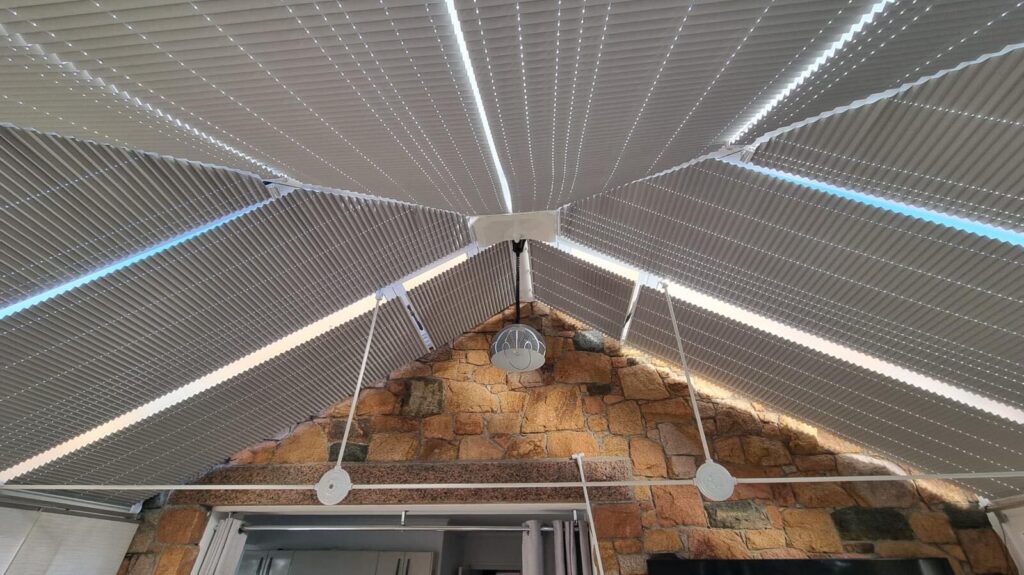
Roof systems solve this with tension. The fabric runs between two tensioned side channels or stainless steel wires that hold it taut against the pitch, with the pleats compressing into a tight stack at one end when the blind is open. That tension is what makes a roof blind a specialist product rather than a normal blind mounted at an angle, and it is why the fabric options are narrower than for a window: a fabric has to be light enough to tension properly and stable enough not to stretch over years of heat cycling.
It also means the glass matters. A rooflight is permitted a worse limiting U-value than vertical glazing under UK Approved Document L, 2.2 W/m²K measured in the horizontal plane, precisely because tilted and horizontal glass loses more heat than a vertical pane. Your roof glazing is very probably the least thermally efficient surface in the room before you add anything to it. The blind is doing real work.
Pleated Roof Blinds
A pleated blind is a single layer of fabric concertinaed into crisp folds, tensioned between side wires or channels and stacking tightly when open.
What it does well. Pleated systems are the lighter of the two, which means they tension neatly across bigger spans and stack into a smaller bundle when retracted, so they take less of your glass when you want the light. The fabric range is the widest available for roofs, and this is where the specialist solar fabrics live. Reflective pleated fabrics, usually carrying a metallised backing that faces the glass, turn back somewhere between 74 and 85 per cent of the sun’s heat before it enters the room. For a south or west-facing conservatory in a Jersey summer, that reflective layer is the single most effective thing you can put between yourself and the sky.
Where it gives ground. A single layer of fabric traps only the thin film of air between itself and the glass. It reflects heat away extremely well and it insulates against the cold only modestly. In November, a pleated roof blind will take the chill edge off and it will not keep a glass room genuinely warm.
Choose it when the room is south or west-facing, summer overheating and glare are the problem you are actually solving, the spans are wide, or you want the widest choice of colours and finishes. Our pleated blinds page shows the range.
Honeycomb Roof Blinds
A honeycomb blind, sometimes called a cellular blind, is two layers of fabric bonded into a row of hexagonal cells that hold a pocket of still air when the blind is extended.
What it does well. Still air is an excellent insulator, and that is the whole idea. The trapped air in the cells sits between the room and the cold glass and slows heat escaping upward, which is exactly the direction heat wants to go in a conservatory. Conservatory-specific honeycomb fabrics are credited with reducing heat loss through the roof by up to 55 per cent. Honeycomb also diffuses light beautifully rather than simply blocking it, giving a soft, even glow instead of a bright patch and a dark corner, and the cell structure absorbs a noticeable amount of sound, which is worth something under heavy Jersey rain on a glass roof.
Where it gives ground. Two bonded layers plus the cell structure means more fabric, more weight and a bigger stack. A honeycomb blind takes up more of your glass when it is fully open than a pleated one, it is more demanding to tension across a wide span, and it costs more per square metre. The solar fabric range is narrower than the pleated equivalent, so if your problem is purely a blazing south-facing summer, the very best reflective performance sits on the pleated side.
Choose it when you want to use the room through the winter, the conservatory faces north or east, the room is a dining room, study or anything you heat and occupy year-round, or you want the light quality and the quieter room. Our honeycomb blinds page has more.
The Comparison, Side by Side
| Feature | Pleated | Honeycomb |
|---|---|---|
| Construction | Single layer, concertina folds | Two bonded layers forming air-filled cells |
| Summer heat | Excellent with a reflective fabric, turning back 74 to 85 per cent of solar heat | Good, though the top solar fabrics sit on the pleated side |
| Winter warmth | Modest. Takes the edge off | Strong. Up to 55 per cent less heat loss through the roof |
| Light quality | Filtered, with a wide choice of transparency | Softly diffused and very even |
| Stack when open | Compact, takes less glass | Bulkier, takes more glass |
| Wide spans | Handles them more easily | Heavier, so spans are more limited |
| Sound | Little effect | Noticeably absorbs noise, including rain on glass |
| Fabric choice | Widest available for roofs | Narrower, particularly in solar fabrics |
| Relative cost | Lower | Higher |
| Best for | South and west-facing rooms, summer glare, wide roofs | Year-round rooms, north and east-facing, winter comfort |
The honest summary is that pleated blinds are the better answer to sun and honeycomb blinds are the better answer to cold, and most Jersey conservatories have both problems in different seasons. Which one wins depends on which season currently stops you using the room. That is the question to ask yourself, and it is the first one we will ask you.
There is no rule saying a single room must use one system throughout, either. It is entirely reasonable to specify honeycomb on the roof for winter insulation and pleated on the side windows for solar control, or to run different fabrics on different pitches of the same roof where one faces the afternoon sun and another does not.
Lantern Roofs and Orangeries
A roof lantern is a different problem to a conservatory roof, and it is the one we are asked about most often now that so many Jersey extensions and orangeries have one.
A lantern sits in a flat or shallow roof as a raised glazed structure, usually rectangular, with sloping sides meeting a ridge. That geometry changes three things. The glazing is often higher above the floor than a conservatory roof, so reaching it is genuinely impractical and motorisation stops being a luxury. The lantern usually has substantial glazing bars dividing it into distinct panes, which means the shading is made as a set of individual blinds fitted between the bars rather than one large blind across the whole roof, and each of those has to be measured separately. And because a lantern is frequently the only source of daylight in the middle of a deep room, over a kitchen island for instance, the choice about light quality matters more than it would in a conservatory with glazed walls on three sides. This is where honeycomb tends to win, because diffused light across a whole ceiling opening reads far better than a bright rectangle.
Orangeries sit somewhere between the two, with a flat perimeter roof and a central lantern, and they are usually shaded as a lantern rather than as a conservatory.
Sunshade Blinds is the only company in Jersey fitting conservatory roof blinds, lanterns and orangeries included, made to the exact shape and pitch of the structure.
If your glazing is a Velux or a roof window rather than a conservatory roof or a lantern, that is a different product again, and our guide to skylight and Velux blinds is the right place to look.
Motorisation Is Not Optional Up There
On a window, motorisation is a convenience. On a roof, it is usually the difference between blinds you adjust and blinds you set once and never touch again.
Roof glazing is above head height by definition, and a manual roof blind is operated with a pole. In practice, people stop bothering after the first fortnight, which means the blind sits in one position and does half the job it was bought for. A blind that is closed all summer keeps the room cool and dark when you wanted cool and bright. A blind that is open all winter is decoration.
Motorised roof blinds solve this with a remote, an app or, best of all, a schedule. A schedule that closes the roof against the middle of the day and opens it as the afternoon cools holds the room at a comfortable temperature without anyone deciding to do anything, which is what actually delivers the thermal performance the fabric is capable of. Where a room is used at predictable times, this is the single change that makes the biggest difference to how the space feels.
Measuring and Fitting a Glass Roof
Roof blinds are measured pane by pane, not roof by roof. Every panel between glazing bars is its own blind with its own dimensions, and on an older conservatory those panes are frequently not identical to one another even when they look it.
The survey needs the exact glazing bar spacing, the pitch of each roof plane, the depth available for the tensioning channels or wires, and a decision about where the stack sits when the blind is open, because on a sloped roof the stack can sit at the ridge or at the eaves and the choice affects both the view and how much light you get back. It also needs to account for anything that intrudes into the glazing, such as trickle vents, opening roof vents or the fixings for an existing structure.
This is work best done from a survey rather than from your own measurements, and every Sunshade Blinds quote includes a free home consultation and measure. We take the measurements, we bring fabric samples so you can hold them up against your own roof and your own light.
Frequently Asked Questions
Which is better for a conservatory roof, pleated or honeycomb?
It depends on which season stops you using the room. Pleated blinds with a reflective solar fabric are the stronger answer to summer heat and glare, turning back 74 to 85 per cent of solar heat, and they handle wide spans more easily. Honeycomb blinds are the stronger answer to winter cold, with conservatory-specific fabrics reducing heat loss through the roof by up to 55 per cent, and they diffuse light more softly. South and west-facing rooms usually favour pleated. Rooms used year-round usually favour honeycomb.
Can I have honeycomb on the roof and pleated on the windows?
Yes, and it is a sensible specification in a lot of Jersey conservatories. The roof does the thermal work and the windows do the glare and privacy work, so choosing each for its own job rather than matching them throughout often gives a better result for the same money.
Do lantern roof blinds work differently to conservatory roof blinds?
The principle is the same but the installation is not. A lantern is shaded as a set of individual blinds fitted between its glazing bars, each measured separately, rather than as one blind across a whole roof plane. Lanterns are usually higher and harder to reach, so motorisation matters more, and because a lantern is often the only daylight in the middle of a deep room, the diffused light from honeycomb tends to suit it better.
Why does motorisation matter more on a roof than on a window?
Because roof blinds sit above head height, and working them with a pole is enough friction that most people stop adjusting them. The blind then sits in one position and delivers a fraction of what it could. A scheduled motorised blind adjusts itself, and that is what actually produces the temperature control the fabric is rated for.
How much of the summer heat will roof shading actually stop?
Most of it, though not all. A reflective roof fabric turns back roughly 74 to 85 per cent of the sun’s heat before it enters the room, which matters because a glass roof takes direct overhead sun for far longer in the day than a vertical window does. Combined with shading on the side windows and some ventilation, the result is a room that is comfortable through a Jersey summer rather than one you avoid between noon and five.
How long do conservatory roof blinds last?
The fabric and the tensioning hardware are what determine it. Roof blinds live in the harshest position in the house, with more ultraviolet exposure and far greater temperature swings than any window blind, so specification matters. A fabric chosen for roof use and hardware rated for the span will last many years. A window product mounted at an angle will not.
Getting the Specification Right
The difference between a glass room you use and one you walk through is usually a specification decision made at survey, not a product decision made from a brochure. Which way the roof faces, when you actually want to sit in there, how wide the panes are and how high the glass sits all point towards one system or the other.
Book a free home consultation and we will survey the roof properly, talk through how you use the room, and bring pleated and honeycomb samples so you can hold both up against your own glass before you decide. No obligation, and a clear written price with fitting included.