


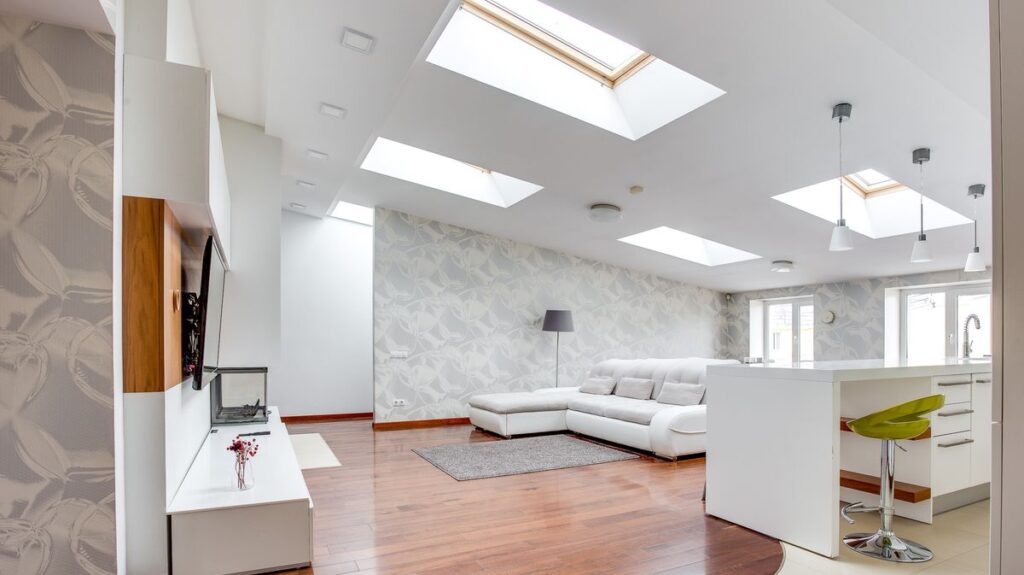

There is nothing quite like a roof window. A vertical window gives you a view; a roof window gives you the sky. It pulls daylight deep into a converted loft, lifts a kitchen extension out of gloom, and turns a landing from a corridor into a place. On an island that gets more sunshine than anywhere else in the British Isles, glazing your roof is one of the best design decisions you can make.
It is also the most demanding glass in your home. The same position that makes a roof window so generous with light makes it work harder than any other window you own: more sun in summer, more heat loss in winter, and, in June, a sunrise that arrives in your bedroom a few minutes after five in the morning whether you asked for it or not.
The answer is not less glass. It is the right blind. Here is what actually matters when you are choosing Velux and skylight blinds in Jersey, and the mistakes worth avoiding.
The Hardest-Working Glass in Your Home
Roof windows behave differently from vertical windows for one simple reason: they face the sky.
In summer, a vertical window receives direct sun for only part of the day as the sun moves around the house. A roof window is exposed to high overhead sun for most of it. There is no eave to shade it, no neighbouring building to soften it, and in the middle of a July day the sun is close to perpendicular to the glass, which is exactly when it delivers the most heat. This is why a converted loft or a glazed extension can feel wonderful in April and punishing by mid-afternoon in July.
In winter, the physics reverses. Warm air rises, so the warmest air in the room sits directly against the coldest, most exposed pane in the house. Tilted and horizontal glazing loses heat faster than the same glass standing vertically, and building regulations quietly acknowledge it: UK guidance permits rooflights a higher heat-loss rating than vertical windows precisely because glazing in a roof gives up more warmth. Your heating bill pays the difference.
None of this is an argument against roof windows. It is an argument for dressing them properly, because a well-chosen blind addresses every one of those problems at once and lets you keep everything you loved about the window in the first place.
The Summer Question: Keeping the Heat Out
If you have a room under a roof window that overheats, the goal is to stop solar heat at the glass, or as close to it as possible.
For most Jersey homes the practical answer is a made-to-measure Velux or skylight blind in a reflective or tightly woven fabric, fitted so that it sits flush against the window with no open edges. Pleated and honeycomb fabrics do this particularly well. Their cellular structure traps a layer of still air against the pane, and a pale or reflective top surface sends a large share of the sun’s energy straight back out through the glass before it ever warms the room.
The fit is not a detail here, it is the mechanism. A blind that leaves open gaps around the edges lets hot air spill around it and into the room. A blind held in side channels keeps that heated layer contained at the glass, which is why the same fabric can perform so differently in a proper fitting than in an approximate one.
If the space in question is a conservatory or a glazed roof rather than a single window, the same thinking applies at a larger scale, and our conservatory blinds guide covers it in depth.
The Winter Question: Keeping the Warmth In
The blind that shades you in July earns its keep again in January. Honeycomb and pleated fabrics insulate in both directions: the trapped air that keeps heat out in summer slows the warm air of the room from reaching the cold glass in winter. It is the same principle that makes honeycomb blinds the standout performer in independent thermal testing, which we looked at properly in our guide to whether blinds reduce energy bills.
On a roof window the winter case is stronger still, because the glass you are insulating is the most exposed in the house. It faces the open sky, it takes the wind directly, and the warmest air in the room is pressed against it all evening. Closing a snug, cellular blind over that pane at dusk is one of the simplest comfort upgrades a converted loft can have: the room holds its temperature, the radiator works less, and the space under the roof stops being the room that is always slightly colder than the rest of the house.
The Sleep Question: Darkness on Demand
Here is the one that brings most people to us. Around the summer solstice, the sun rises over Jersey a few minutes after 5am. In a loft bedroom with an undressed roof window, that is not a poetic fact, it is an alarm clock you cannot switch off, positioned directly above your bed.
Light is the main signal that sets your body clock. Morning light suppresses melatonin, the hormone that keeps you asleep, which is exactly what you want at 7am and exactly what you do not want two hours earlier. Proper darkness is not a luxury in a bedroom; sleep research consistently links it to better, longer sleep.
This is where a genuine blackout blind matters. Velux’s own blackout blinds are rated to block light completely through the fabric, and the side channels they run in are designed to close off the edges where light would otherwise creep around the blind. That construction is the difference between a dark room and a dim one. A curtain cannot do this on a sloping window, and a loosely fitted blind will always leak at the corners.
For a loft bedroom we would pair a blackout skylight blind with whatever the vertical windows need, and our guide to the best blinds for bedrooms covers that side of the room. Do it once, properly, and a June morning starts when you decide it does. If you like, add blackout blinds with the same discipline elsewhere: children’s rooms and nurseries feel the benefit fastest of all.
Fit Decides Everything on a Roof Window
On a vertical window, a slightly imperfect blind still hangs straight. On a sloping window, gravity is against you. A skylight blind has to hold its position and its tension at an angle, which is why every serious skylight blind runs in side channels or on tensioned guide wires, and why the blind must match the exact window it is fitted to. There is no forgiving overlap to hide behind.
The good news is that roof windows make precision easy, if you know where to look. Open a Velux window and look at the top edge of the sash: there is a small data plate showing the window’s type and size code, something like GGL MK04. That code identifies the exact model and dimensions, which means a blind can be made to fit it exactly, channels and all. Every Velux window made since 1968 has one.
This is also where we would gently steer you away from the generic online options. A blind that “fits most skylights” fits none of them precisely, and on a sloping window, precisely is the entire job. Sunshade Blinds supplies genuine Velux blinds, made for the exact window code on your data plate, in roller, Venetian and pleated styles across a wide choice of fabrics. We measure, we confirm the codes, and we fit. If a code plate is missing or unreadable, we will identify the window on site.
Out of Reach? Let the Blind Come to You
Plenty of roof windows sit exactly where a human being cannot: above a stairwell, at the top of a vaulted kitchen, over the bath. A blind you cannot reach is a blind you will never adjust, and the room ends up permanently too bright or permanently shaded.
Motorisation solves this completely. Many of the Velux blinds we fit are motorised and arrive pre-paired with a wall switch, so an unreachable window becomes a one-touch decision. Go further and motorised blinds can run to a schedule: shading the glass automatically through the hottest hours of a summer afternoon, closing at dusk in winter to hold the day’s warmth, opening a bedroom gently with the morning. Our electric blinds FAQs answer the practical questions, from power options to what happens in a power cut.
It is worth saying plainly: nobody should be balancing on a ladder over a stairwell twice a day to twist a skylight pole. Motorise it and forget it.
Which Skylight Blind for Which Room
Every home is different, but the patterns are consistent enough to share.
Loft bedrooms. Blackout, always, in side channels. Consider motorisation if the window sits high in the pitch. Darkness for sleep first; everything else second.
Kitchen extensions. Heat control is the priority under a glazed roof. Reflective pleated or honeycomb fabrics in easy-clean finishes handle steam, spills of light and the midday sun.
Bathrooms. Moisture-resistant fabrics and privacy without losing the daylight that makes a bathroom feel clean. Pleated fabrics in humidity-tolerant finishes work well here.
Stairwells and landings. Almost always out of reach, so motorise. A landing skylight on a schedule keeps the heart of the house bright by day without cooking the top floor in August.
Home offices under the roof. Glare is the enemy. A light-filtering pleated fabric softens overhead sun into workable light; blackout is rarely the right answer in a workspace.
Made for Jersey Light
We have been dressing Jersey’s windows since 1987, and roof windows are some of our favourite work, because the difference a proper blind makes is so immediate. The loft that was too hot to use becomes the best room in the house. The 5am bedroom becomes dark until you choose otherwise. The stairwell skylight starts earning its keep at the touch of a switch.
Every skylight blind we fit is made to measure for the exact window it will live on, chosen for how the room is actually used, and fitted by our own team. It starts with a conversation and a tape measure, at your home, at no cost.
Frequently Asked Questions
Do I need a genuine Velux blind for a Velux window?
A Velux window needs a blind made precisely for its model and size code, and genuine Velux blinds guarantee that fit, including the side channels that control light and heat at the edges. Sunshade Blinds supplies genuine Velux blinds in roller, Venetian and pleated styles, made for the exact code on your window’s data plate.
How do I find out which Velux window I have?
Open the window and look at the top edge of the sash. A small data plate shows the type and size code, for example GGL MK04, which identifies the exact model and dimensions. If the plate is missing or worn, we can identify the window during a free home visit.
Can blinds really keep a skylight room cooler in summer?
Yes. A roof window receives high overhead sun for much more of the day than a vertical window, and a close-fitting reflective or honeycomb blind stops a large share of that heat at the glass. The fit matters as much as the fabric: side channels keep the heated air contained against the pane instead of spilling into the room.
Are blackout skylight blinds worth it for a loft bedroom?
For anyone sleeping under a roof window, yes. In midsummer the sun rises over Jersey shortly after 5am, directly above an unshaded loft bedroom. Velux blackout blinds block light completely through the fabric and run in side channels designed to close off the edges, which is what turns a dim room into a genuinely dark one.
What if my skylight is too high to reach?
Motorise it. Many of the Velux blinds we fit are motorised and come pre-paired with a wall switch, and they can also run on a schedule, shading automatically in summer and closing at dusk in winter. It is the standard answer for stairwells, vaulted ceilings and any window you would otherwise need a ladder for.
Sleeping under a skylight, or living under one that runs too hot? Book a free home consultation. We will identify your exact windows, recommend the right fabrics and controls for each room, and measure everything ourselves, so every blind arrives made for the window it will live on. No obligation, just honest advice from Jersey’s longest-established blind manufacturer.