


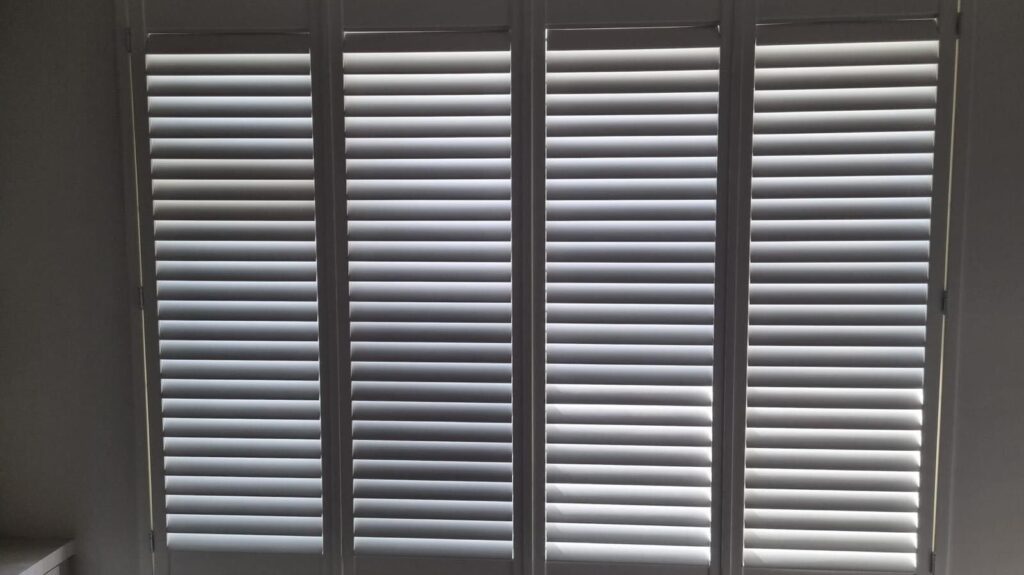

Shutters change a room in a way almost nothing else does. Louvres tilted halfway turn hard midday glare into something soft and horizontal that falls across a floor in bands. Closed, they give you a room that is genuinely dark and genuinely private. Open, they frame a window rather than hanging over it. That is why people who choose shutters rarely go back to anything else.
If you have already decided that shutters are what you want, this guide is about buying them well. What they cost in Jersey, why we only fit hardwood, why measuring is the step that goes wrong, and the questions worth asking before you commit. If you are still weighing shutters against other options, our guide to shutters against blinds is the better starting point, and this guide will still be here afterwards.
Why Shutters Suit Jersey Homes
Two things about the island make shutters work harder here than they would elsewhere.
The first is the housing stock. A large share of Jersey’s homes are old granite buildings. Openings in older island homes are rarely square, rarely standard, and rarely the same as the one next to them. Deep reveals, splayed jambs, arched heads, and window frames that have moved gently over a century or two are all normal. This is exactly the situation where a made-to-measure shutter earns its cost, because it is built to the opening you actually have rather than the opening a catalogue assumes you have. An off-the-shelf covering fights a wonky reveal. A properly measured shutter sits in it as though the house came with it.
The second is the light. Jersey averages over 2,000 hours of sunshine a year, and a good deal of it arrives low and off the water. Low sun is the difficult kind, because it comes in under the top of a window where a roller or a Roman blind cannot easily reach without darkening the whole room. Adjustable louvres are the answer to low light specifically. You tilt the top few louvres against the glare and leave the rest open, and the room keeps its view and its brightness while the sun stays out of your eyes.
There is a third point worth making plainly. Shutters are a fixture rather than a furnishing. They are screwed into the reveal, they stay when you move, and estate agents frequently cite well-installed shutters as improving a property’s presentation, desirability and buyer perception. The effect on value varies from property to property and nobody should buy shutters purely as an investment, but the figure often quoted is an uplift of around 3 to 5 per cent on sale value. It is a reasonable thing to weigh alongside the cost.
What Plantation Shutters Cost in Jersey
Shutters cost more than blinds. Anyone who tells you otherwise is selling something else. It is worth understanding what the difference buys and where the figure comes from.
We do not publish a per-window price list, for the same reason we do not for blinds: every window is measured and made individually, and a number quoted without a survey is a number that changes later. What we can give you is the shape of real projects. Across the Jersey homes we work in, most domestic window treatment projects land between £800 and £5,000, and a scheme leaning on shutters sits towards the upper end of that range rather than the lower. Our guide to what blinds cost in Jersey sets out the full picture across every product.
Five things move a shutter price:
The size and shape of the opening. Price tracks material and the engineering needed to carry it. A tall window needs a mid-rail so the louvres do not sag across the span. A bay needs several panels and a plan for how they meet at the angles. An arched or circular head is cut and shaped individually and costs accordingly. Standard rectangles are the least expensive thing you can put a shutter in.
The timber and finish. Every shutter we fit is hardwood, so the price differences come from the finish and the work rather than from a lower grade of material. The next section explains why we keep it that way.
The louvre width. Louvres commonly range from around 47mm to 114mm. Narrow louvres suit small windows, cottage proportions and period properties, and give more privacy when closed. Wide louvres suit larger modern windows, let in more light when open, and give a cleaner view out because there are fewer slats crossing it. Wider louvres generally cost a little more.
The configuration. A full-height panel is the most straightforward. Tier-on-tier, where the top and bottom halves open independently, costs more because it is effectively two shutters in one opening. Tracked shutters for wide patio doors and shaped shutters for non-rectangular openings both carry a premium for the additional work.
The finish. A painted finish, a stained finish and a natural timber finish are priced differently, and a colour matched to something specific in your room costs more than a standard white.
Two things are worth knowing about buying on the island rather than ordering from the mainland. Every Sunshade Blinds quote includes professional measuring and fitting, so there is no installation charge arriving at the end. And every figure includes Jersey GST at 5 per cent rather than UK VAT at 20 per cent, which closes more of the gap against an online mainland price than most people expect once delivery to Jersey is added in.
Why We Only Fit Hardwood
Sunshade Blinds fits hardwood shutters and nothing else. We are sometimes asked why, so here is the honest answer.
Hardwood looks and feels like the real thing because it is. Real timber takes a paint or a stain beautifully and has genuine grain and weight. It is also lighter per panel than the alternatives, which matters on large openings because a lighter panel puts less strain on its hinges.
It copes with damp rooms. Hardwood is dense, stable timber, and a properly finished hardwood shutter is fine in a bathroom, an en-suite, a steamy kitchen or a sea-facing room. You do not need to switch to a different material for the wetter rooms in the house.
It can go outside. If you want shutters on the outside of a window, hardwood can be fitted there too.
What about plastic shutters? PVC and vinyl shutters are widely sold, usually as the waterproof option. We do not offer them. In our experience they go yellow over time, and they generally cost about the same as hardwood, so the main selling point is a marketing one. Their one real advantage is lead time: many are made in the UK and arrive sooner. If you need shutters in a hurry, that is worth knowing. If you want them to look right in ten years’ time, we think hardwood is the better buy.
We fit hardwood shutters in plantation, tier-on-tier, café-style, shaped, tracked and solid styles, so the specification is still chosen room by room.
Choosing a Style for the Room
Style is usually decided by what the room needs rather than by what looks best in a photograph.
Full-height shutters cover the whole opening as a single run of louvres. The cleanest and most architectural of the options, and the default for most living rooms and bedrooms. Add a mid-rail on a tall window so the top and bottom sections tilt independently, which is more useful in practice than it sounds.
Café-style shutters cover only the lower part of the window and leave the top open. Made for a ground-floor room facing a road or a pavement, where you want privacy at eye level and as much daylight as possible above it. Common in St Helier terraces and anywhere a window looks straight onto a lane.
Tier-on-tier shutters cover the full height in two independently opening halves. The most flexible configuration there is, and the one that suits period properties and sash windows, where you can close the bottom for privacy through the day and fold everything back in the evening.
Tracked shutters run on a top track so panels slide and stack to one side, which is how you cover a wide patio door or a run of bi-folds without a hinged panel swinging into the room.
Shaped shutters are cut for arched heads, angled gable windows, circles and triangles. This is specialist work, it costs more, and it is often the thing that makes an awkward window finally look deliberate.
Shutters in Coastal and Damp Rooms
This is the part most guides skip, and on this island it matters more than anywhere.
Salt does not need to reach a window directly to affect it. Salt-laden air carries inland and settles on surfaces, and it is hygroscopic, meaning it draws moisture out of the air and holds it against whatever it has settled on. A shutter in a sea-facing room is therefore sitting in slightly damper conditions than the same shutter three miles inland, all year, and the effect compounds over time on any material that is sensitive to moisture.
Hardwood handles those conditions, which is one of the reasons it is the only material we fit. What deserves the most attention in a sea-facing room is the hardware. Wherever salt air reaches, stainless or properly coated hinges and fixings are the difference between a shutter that still swings sweetly in ten years and one that binds and stains long before the panel itself has any complaint.
The same logic applies across every window covering on the island, and our guide to blinds that survive Jersey’s sea air sets out the full picture on materials, fixings and finishes for coastal homes.
Measuring Is the Step That Goes Wrong
A shutter is unforgiving in a way a blind is not. A blind hangs in front of an opening and a few millimetres of discrepancy disappear behind the fabric. A shutter sits inside the opening, and a few millimetres show as a gap along one edge, or a panel that catches on the reveal, or a frame that will not sit flat against a wall that is not flat.
The measurements that matter are not just width and height. A shutter needs the depth of the reveal, because there has to be room for the louvres to rotate without hitting the glass or the handle. It needs to know where the window handles, trickle vents and tie bars sit, because a panel has to clear them. It needs to know whether the opening is square, and by how much it is out if it is not, which in an older Jersey property is almost always the interesting question. And it needs a decision about how the frame meets the wall, which depends on whether the reveal is deep enough for the shutter to sit inside it or whether the frame will be mounted on the face of the wall instead.
None of this is difficult, but all of it needs someone in the room with a laser and an eye for what the house is doing. This is why every Sunshade Blinds quote includes a free home measure. We come to you, take the measurements ourselves, bring physical samples of the materials and finishes so you can see them in your own light, and take responsibility for the numbers.
What to Expect After You Order
Shutters are made to your measurements after you order, so they are not a next-week product. Hardwood shutters typically take 12 to 14 weeks from order to fitting. We confirm the date for your project at the point of quotation, and if you want shutters in place for a particular date, it is worth talking to us early.
Fitting itself is usually a single visit for a normal domestic project. The panels are hung, the frames are fixed, the louvres are adjusted, and the room is left clean.
Frequently Asked Questions
How much do plantation shutters cost in Jersey?
There is no single per-window figure, because every shutter is measured and made for the opening it goes into. What we can tell you is the shape of real projects: most domestic window treatment projects in Jersey land between £800 and £5,000, and a shutter-led scheme sits towards the upper end of that range. The price is driven by the size and shape of the opening, the material, the louvre width, the configuration and the finish. Every quote includes professional measuring and fitting, and every figure includes Jersey GST at 5 per cent rather than UK VAT.
Are shutters better than blinds?
They are different rather than better. Shutters last longer, insulate a little better, give finer control over low sun, and stay with the house as a fixture. Blinds cost less, offer far more choice of fabric and colour, and suit some windows better, particularly very large ones. Our guide to shutters against blinds sets out the comparison properly.
Can I get shutters for a bathroom in Jersey?
Yes. We fit hardwood shutters in bathrooms, en-suites and kitchens. Hardwood is a dense, stable timber, and a properly finished hardwood shutter copes with a room that gets wet. You do not need plastic shutters for a bathroom, and we do not offer them, because in our experience they go yellow over time and rarely cost any less.
Will shutters fit an old Jersey property with uneven windows?
This is what made-to-measure shutters are for. Deep granite reveals, out-of-square openings, arched heads and splayed jambs are all normal in island properties and all workable. The shutter is built to the opening you have, and where an opening is significantly out of square the frame is designed to take up the discrepancy so the panels still sit and close properly. It is the reason measuring on site matters so much.
Do shutters help with heat and noise?
They help with both, though they are not a substitute for glazing. A closed shutter puts a solid layer and a pocket of still air between the room and the glass, which slows heat moving in either direction and takes the edge off outside noise. Solid shutters, which have panels rather than louvres, do more of both than louvred ones.
How long do shutters last?
Properly made and properly fitted, decades. Two things decide it. The first is the fit, which is why we measure every opening ourselves. The second is the hardware, because hinges and fixings that are not up to salt air are the usual reason a shutter starts to bind or stain. Get those right and a hardwood shutter is one of the longest-lived things you can put in a window.
Seeing Them in Your Own Light
Shutter samples look different in a showroom than they do in the room they are going into, and paint colours look different again against your walls and under your light. That is the main argument for having someone come to you.
Book a free home consultation and we will measure your windows properly, bring material and finish samples to hold up against your own light, talk through which style suits which room, and give you a clear written price with fitting included. No obligation, and no pressure.