



Blinds that survive Jersey’s coastal conditions: A homeowner’s guide
A new blind in the wrong material will fail in a Jersey home faster than almost anywhere else in the British Isles. We have seen it more times than we would like: the real-wood Venetians that warped within a winter at St Ouen’s Bay, the powder-coated aluminium headrails pitted where salt pooled after a westerly storm, the roller fabric that turned from charcoal to dusty grey on a south-facing living room inside three summers.
Blinds can elevate a Jersey home, but the conditions are harsh, with strong UV exposure, high humidity and salt-laden coastal winds that can quickly wear down lesser materials. The island averages just over 2,090 hours of sunshine a year, more than anywhere else in the British Isles. Winter and spring humidity sits comfortably in the 80 to 86 per cent range. The prevailing wind is a south-westerly straight off the Atlantic, salt-laden and relentless through the western bays. To a window treatment, that combination is three separate assaults running at the same time.
After 35 years fitting blinds and shutters across Jersey, from granite cottages hidden away in St Mary to contemporary homes surrounding the St Ouen’s dunes, we have learned exactly which materials survive and which ones do not. This guide walks through the science, the products, and the room-by-room decisions that protect your investment in a coastal home.
What the Atlantic actually does to a window treatment
Three forces work on every blind in a sea-facing Jersey home. Understand them and the material choice becomes obvious.
UV
Ultraviolet radiation breaks the polymer chains inside fabric fibres, a process called chain scission. Colour fades first, but the real damage is structural: a fabric that still looks acceptable at five years may have lost a significant portion of its tensile strength.
This is why the international lightfastness standard (ISO 105-B02) matters. Fabrics are rated against the Blue Wool scale from 1 (very poor) to 8 (excellent). A Blue Wool 5 is considered the minimum for drapery; 7 or above is what you want for anything facing direct sun. Solution-dyed acrylics (the material behind our awning range) protect the fibre from within. The pigment itself is UV-stable, which is why premium manufacturers can cover both fade and strength loss under a ten-year warranty.
Salt
Salt does not simply settle on surfaces. Airborne chloride is hygroscopic, meaning it pulls moisture from the air and holds it against the metal beneath. On steel chains, brackets, or uncoated fixings this triggers pitting corrosion within months. On aluminium it is slower but not immune. Once a powder coating is chipped or scratched, salt finds its way under the film and lifts it from within.
The international standard for atmospheric corrosivity (ISO 9223) classifies environments from C1 (indoor dry) through to CX (extreme offshore). Jersey’s coastal zone, within 2,000 metres of the shore, sits firmly in C4 (high) to C5 (very high) territory. The British and European coating standard for architectural aluminium, BS EN 12206-1, draws its line at exactly that 2,000-metre threshold. Any installation closer to the sea needs to be specified for coastal use, and most of Jersey’s parishes lie inside that line.
Humidity
The last force is the quiet one. Jersey’s winter and spring humidity regularly sits between 82 and 86 per cent. That is enough to swell untreated timber, warp MDF shutter louvres, and feed mould behind lined Roman blinds that never quite dry out. It is also enough to soften lower-grade faux-wood slats if they are exposed to 40°C-plus south-facing conservatory heat at the same time.
A blind that performs well in a coastal Jersey home has to cope with all three of these forces simultaneously, often in the same room.
Materials ranked: What we have seen survive
Hardwood plantation shutters: the coastal shutter we fit
Hardwood plantation shutters bring a level of craftsmanship and permanence that elevates any interior. The larger louvres allow excellent airflow and light modulation, and the solid frame integration gives them a built-in, architectural feel rather than a temporary dressing. They are an initial investment, but they are straightforward to clean, built to last as long as the house itself, and remain the most substantial option available in terms of longevity and durability.
Hardwood is dense, stable timber, and a properly finished hardwood shutter copes with damp, steam and sea air. That is why it is the only shutter we fit: in a sea-facing living room, a coastal bathroom or a kitchen, and on the outside of a window if you want one there. What needs the most care in a salt-air home is the hardware. Specify stainless or properly coated hinges and fixings, and the shutter will keep swinging freely for years. Estate agents frequently cite well-installed shutters as improving a property’s presentation and buyer appeal.
Honeycomb blinds: thermal efficiency with a coastal caveat
Honeycomb (cellular) blinds are engineered for insulation. Their pleated structure traps air within pockets, often incorporating a foil lining on the inside of the cells to further reflect heat, creating a thermal barrier that helps retain warmth in winter and reduce solar gain in summer. In energy-conscious homes, they are one of the most effective internal shading options available, particularly for large glazed areas or modern builds where heat loss is a concern. Their soft appearance also suits bedrooms and living spaces where a more minimal, fabric-led finish is preferred over hard slats.
Faux wood Venetians: the coastal default
Faux wood Venetians are the single most common blind we specify in Jersey coastal homes, and the reason is simple physics. PVC and composite faux-wood slats do not absorb moisture. They do not warp in humidity. They will not grow mould on their surface. You can wipe them down with a damp cloth, and if you live close enough to the sea that salt builds up on the headrails, a quick fresh-water rinse dissolves it before it can do harm. Lighter colours reflect heat in summer and bounce daylight deeper into the room.
The caveat: in south-facing conservatories or sun rooms, internal temperatures behind the glass can exceed 55°C on peak summer days. Standard PVC faux-wood starts to soften around that threshold. For those rooms we specify either lighter colours (which absorb less heat) or ABS composite slats, which have higher temperature tolerance.
Aluminium Venetians: precision light control where water is present
Aluminium Venetian blinds are a strong coastal choice for utility rooms and bathrooms, or places with a shallow recess or a Perfect Fit blind with no drilling. Aluminium is roughly ten to a hundred times more corrosion-resistant than untreated steel in marine atmospheres, thanks to the self-passivating oxide layer that forms on its surface. The metal itself will outlast the building it is fitted in. The vulnerability is the finish: powder coating needs to be specified to BS EN 12206-1 for coastal locations, with a minimum film thickness and a seaside-grade pre-treatment. Ask about this. Inferior powder coatings fail at the cut edges first, and once salt reaches the bare aluminium beneath, the finish starts to lift.
What about plastic shutters?
PVC and vinyl shutters are often sold as the waterproof option for coastal rooms. We do not offer them. In our experience they go yellow over time, and they generally cost about the same as hardwood. Their one real advantage is a shorter lead time, as many are made in the UK.
PVC and waterproof rollers: for the practical rooms
Wipe-clean PVC roller blinds handle kitchen splashes, condensation, and the occasional rogue wave of cooking steam without complaint. For utility rooms, downstairs loos, and bathrooms, a waterproof roller is straightforward, durable, and genuinely low-maintenance. For landlords in particular, they are a sensible specification: cost-effective, hard-wearing, and easy to turn around between tenancies with minimal upkeep or replacement.
A strong example is the Ferrari Soltis Perform 92, a high-performance technical fabric that is stocked and readily available. It features a micro-perforated composite with an aluminium (foil) core, giving it excellent dimensional stability, moisture resistance, and opacity. The material is designed for demanding environments, resisting mould, staining, and UV degradation, while still being simple to wipe clean. In rental properties or high-use areas, it offers a practical balance between durability, performance, and long-term value.
Awning fabrics: the outdoor front line
On an exposed terrace or garden, the fabric is the first thing the weather touches. We specify solution-dyed acrylic as standard on every awning and canopy we manufacture. It carries the strongest warranty in the industry (typically ten years against fade, strength loss, and mildew) because the colour is embedded in the fibre rather than printed onto it.
The second thing to check is the wind resistance class. The European standard EN 13561 rates external awnings from Class 0 (untested) to Class 3 (Beaufort 6, approximately 30 mph). For a coastal Jersey terrace, Class 3 is the minimum we recommend, and folding-arm awnings capped at Class 2 are generally not the right answer for St Ouen’s or the west-coast bays. Cassette and pergola systems with lateral fabric guides handle higher exposure; we manufacture both at our St John workshop, the only company in the Channel Islands that still does.
Room by room in a coastal home
Sea-facing kitchens
Aluminium Venetians with a seaside-grade powder coating, or PVC rollers if you want a cleaner, minimal look. Both wipe clean. Both handle steam. Both ignore salt if properly specified. Avoid any fabric blind near the hob.
Sea-facing living rooms
This is where the UV calculation matters most. A west-facing living room at St Ouen’s takes the full afternoon sun across Atlantic-reflected light, which amplifies the fade rate. We specify either solution-dyed acrylic roller fabrics (where available) or honeycomb blinds with strong lightfastness ratings. For privacy on ground-floor coastal homes, Allusion blinds or hardwood plantation shutters in a warm natural stain both work beautifully without blocking the view.
Sea-view bedrooms
Blackout is the priority, but coastal bedrooms also need materials that cope with condensation on single-skin walls. Made-to-measure blackout rollers in a wipe-clean fabric, or blackout-lined roman blinds provided the fabric carries a strong lightfastness rating. Motorisation adds another layer of protection: a Somfy-powered blind on a dawn/dusk schedule limits the hours the fabric sits under direct sun, which genuinely extends its useful life.
Coastal bathrooms
Hardwood plantation shutters with stainless fittings, or ABS-framed rollers in a moisture-rated fabric. MDF, untreated wood and uncoated metals do not belong in a sea-facing bathroom. The humidity alone will shorten their life; the salt accelerates everything.
Conservatories and sun rooms
This is the hardest room in a Jersey coastal home. Heat, UV, and humidity all peak here. Light-coloured faux wood on vertical windows, solution-dyed acrylic on the roof panels, and where possible a motorised opening schedule so the glass is not continuously superheated. Sunshade is the only company in Jersey that manufactures conservatory roof blinds. It is the one room where specialist local experience genuinely cannot be substituted.
Exposed terraces
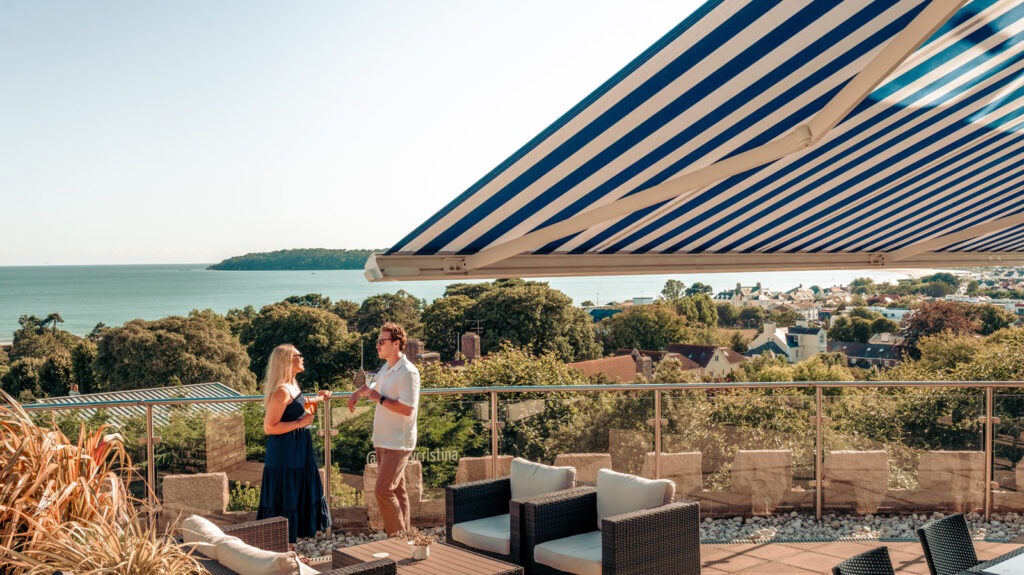
Class 3-rated awnings in solution-dyed acrylic, ideally with a wind sensor that retracts the fabric automatically when gusts pass the threshold. Retractable is always the right call on the Jersey coast: a fabric that lives indoors for most of the year ages at a fraction of the rate of one permanently exposed.
The maintenance routine that adds years
The maintenance discipline is simpler than most people expect, and it is the single biggest factor in how long your blinds last.
Every week: Dust the slats and headrails on any blind in a sea-facing room. Salt settles invisibly; dust it off before it has time to attract moisture.
Every month: Damp-wipe aluminium, PVC, and faux-wood surfaces with fresh water. On exterior awnings and shutters, rinse the fabric and frames with clean tap water. This is not a consumer-marketing line, it is genuine marine maintenance practice. A fresh-water rinse dissolves chloride crystals before they can pit or stain.
Every quarter: Inspect the exterior fixings on awnings and shutters. Check for any coating damage, tighten any loose brackets, and spot-treat any corrosion immediately. Left untreated, a pinprick of rust on a steel component becomes a structural problem within a season.
Every year: Book a service visit. We inspect every blind we have fitted, adjust tensions, replace cord stops, and re-lubricate motorised mechanisms as part of our aftercare service.
That routine, properly followed, is the difference between a ten-year blind and a three-year one.
What to ask any fitter before they quote a coastal job
- Is the finish rated for coastal use? For aluminium, ask specifically about BS EN 12206-1 coating thickness and pre-treatment.
- What is the fabric’s lightfastness rating? A Blue Wool 5 or higher is the minimum for sea-facing rooms.
- Is the awning fabric solution-dyed, and what is its warranty?
- What EN 13561 wind class is the awning rated to? Class 3 is the coastal minimum.
- Do you manufacture and service locally, or does everything go back to a mainland factory for repairs? Does your supplier have BBSA accreditation and ISO9001 certification
If a fitter cannot answer these questions, they have not specified enough installations to be the right choice for your home. After 35 years in Jersey, we know this climate and these materials inside out, and every quote we write reflects it.
Book a free home consultation and we will walk every room with you, recommend the right specification for each exposure, and bring samples of the materials that have proven themselves across three and a half decades on this island.